
You promoted them for the right reasons. Consistent results. Strong technical command. Respected by peers. So you gave them a team, a budget, and a mandate to deliver.
Then the pressure came. And the cracks appeared.
This story plays out inside Singapore’s boardrooms and regional headquarters every quarter. The best individual contributor becomes the most expensive leadership mistake. Not because they lack intelligence. Not because they lack drive. Because nobody stress-tested their leadership behavior before the business needed it.
That oversight is on the organisation. And it is entirely preventable.
Singapore’s Leadership Pipeline Has a Structural Flaw
Singapore punches well above its weight as a regional business hub. Multinational corporations anchor their Asia-Pacific headquarters here. Regional leadership roles concentrate in this city-state at a density few markets match. Consequently, the pressure on Singapore-based leaders is not hypothetical. It is immediate, cross-cultural, and unforgiving.
Yet most organisations fill their leadership pipeline using a fundamentally flawed logic: past performance predicts future leadership. Decades of organizational psychology research says otherwise. Furthermore, Singapore’s own workplace culture compounds this error significantly.
The “kiasu” instinct that deeply ingrained fear of losing ground or being perceived as inadequate produces a specific leadership failure mode. High performers in Singapore often mask uncertainty with overconfidence. They resist delegating because delegation feels like vulnerability. They avoid surfacing bad news upward because it threatens their carefully maintained image of competence. In a stable environment, these behaviors are invisible. Under genuine business pressure, they become catastrophic.
Your leadership pipeline is full of people who perform brilliantly when conditions are comfortable. The question your organization cannot currently answer is this: who actually leads when conditions are not?
The Performance Review Cannot Answer That Question
Here is what your annual performance review captures with precision: historical output in a structured, low-ambiguity environment. It measures delivery against predefined KPIs. It reflects behavior when the rules are clear and the stakes are known.
Here is what it cannot capture: how an individual makes decisions when information is incomplete. How they communicate under genuine time pressure. Whether they protect their team or protect themselves when a crisis demands a choice. How they handle the moment when their authority is challenged and their instinct is to shut down rather than lead through.
Consequently, organisations that rely exclusively on performance reviews to identify leadership potential are making promotion decisions based on the least relevant data available. They are selecting for office-condition performance and then deploying those leaders into high-pressure environments they have never experienced in any structured, observable way.
This is not a recruitment problem. It is a development methodology problem. And most Singapore organisations are not solving it.
Pressure Is Not the Enemy. Unobserved Pressure Is.
The instinct among many CEOs and MDs is to protect high-potential employees from excessive pressure during their development phase. Give them stretch assignments, yes. But shield them from the full weight of organizational complexity until they are “ready.”
This instinct is understandable. It is also strategically counterproductive.
Neuroscience is unambiguous on this point. The prefrontal cortex the brain’s decision-making and impulse-regulation center does not develop leadership-grade responses through observation or classroom instruction. It develops them through repeated exposure to genuine stress in environments where the consequences of failure are real enough to activate authentic responses, but contained enough to allow recovery and reflection.
In other words, your future leaders need to fail. Specifically, they need to fail visibly, safely, and under expert observation before the failure happens in front of a client, a board, or a regional leadership team reviewing quarterly numbers.
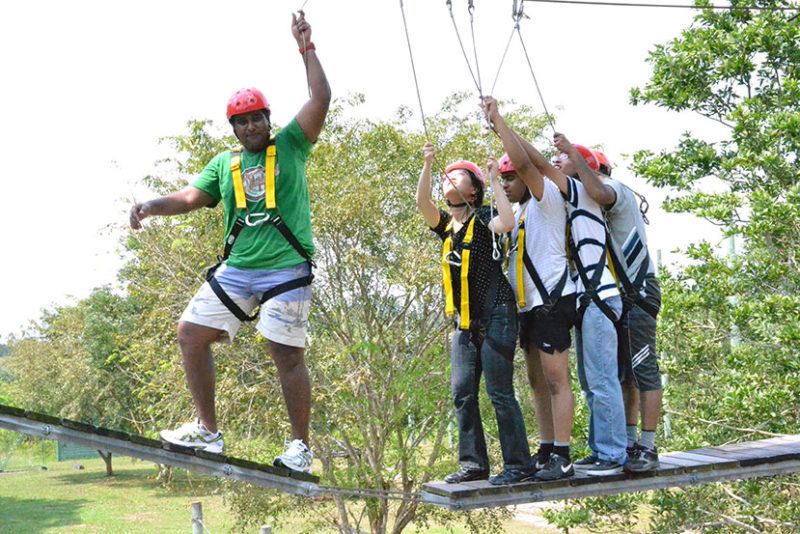
This is the core premise behind Leadership Under Pressure development. Not simulation for its own sake. Deliberate, diagnostically designed pressure scenarios that force authentic leadership behavior to the surface where it can be observed, named, and developed with precision.
What Real Leadership Behavior Looks Like Under a Microscope
We design individual-focused leadership pressure scenarios for CEOs and MDs who need certainty about their pipeline not hope.
Our approach begins before any scenario runs. We conduct structured diagnostic conversations with your executive leadership to identify the specific leadership behaviors your organization needs most. Cross-functional influence without direct authority. Decisive action under incomplete information. Psychological composure during team conflict. Clear communication when the organizational stakes are highest.
Subsequently, we engineer scenarios that isolate exactly those behaviors. A participant does not know which specific behavior we are observing. They experience a genuinely challenging leadership situation a resource crisis, a stakeholder conflict, a team breakdown under a fictional but structurally realistic deadline and they respond with the instincts they actually have, not the instincts they think they are supposed to demonstrate.
This distinction matters enormously. Furthermore, it is the single most important reason why self-assessment leadership tools and 360-degree feedback surveys consistently fail to predict leadership performance under pressure. People report their aspirational behavior. Our scenarios reveal their actual behavior.
The Reflection Layer: Where Development Actually Happens
Pressure without structured reflection produces trauma, not growth. This is where many leadership development programs even well-intentioned experiential ones fall critically short.
Every pressure scenario feeds directly into a structured debrief anchored in Kolb’s Experience-Reflection-Application cycle. The participant first articulates precisely what they experienced and what decisions they made in real time. The facilitator then introduces the observational data specific behavioral moments captured during the scenario and guides the participant through an honest analysis of the gap between their perceived leadership and their demonstrated leadership.
This is not comfortable. It is not designed to be. Consequently, it is also where the most significant behavioral shifts occur. Leaders who genuinely confront the gap between who they think they are under pressure and who they demonstrably are under pressure with expert facilitation and a psychologically safe container develop real capability, not just increased self-awareness.
The Application phase then converts that insight into a concrete behavioral protocol the leader carries back into their actual role. Not a vague intention to “communicate better.” A specific, observable behavioral commitment tied to the exact leadership situation their role demands most frequently.
Why Singapore’s Cultural Context Changes Everything
Leadership development content designed for Western corporate environments routinely misfires in Singapore. The behavioral variables are too specific to ignore.
Singapore’s senior leaders navigate a uniquely complex authority landscape. Respect for hierarchy runs deep across the dominant professional cultures. Consequently, leaders who rely on positional authority function adequately in stable conditions. Under pressure, however, positional authority collapses and leaders who never developed influence-based leadership capabilities are suddenly exposed.
Additionally, Singapore’s regional hub status means most senior leaders manage teams across multiple Asian markets simultaneously. The leadership behaviors that build trust with a Singaporean team do not automatically transfer to Indonesian, Thai, or Vietnamese organizational cultures. Our facilitators understand these nuances with precision. They design scenarios that surface cross-cultural leadership blind spots the specific moments where a Singapore-calibrated leadership style creates friction in a broader regional context.
Generic leadership development programs cannot do this. They apply a universal model to a market that demands cultural specificity. In contrast, our locally grounded, regionally aware methodology ensures the development directly serves the leadership reality your executives face every single day.
The Business Case Is Straightforward
Leadership failure at the senior level is extraordinarily expensive. Conservative estimates from organizational research place the cost of a failed senior leadership hire including replacement, lost productivity, and team destabilization at between 50% and 200% of annual compensation.
Furthermore, the indirect costs are harder to quantify but far more damaging. High-performing team members leave when they lose confidence in their leader. Strategic initiatives stall when leadership decision-making becomes risk-averse under pressure. Client relationships erode when the person managing them cannot hold composure during a service crisis.
In contrast, organizations that invest in pressure-based leadership development before deployment report measurably faster decision cycles, higher team retention under demanding project conditions, and stronger cross-functional collaboration outcomes. The development cost is a fraction of the failure cost. The return timeline is short. The alternative waiting for a real crisis to reveal your leaders’ actual capabilities is not a strategy. It is deferred risk.
You Already Know Which Leaders You Are Not Sure About
Here is the honest question underneath this conversation: you already have two or three names in your mind. People in, or approaching, significant leadership roles in your organization. People whose performance record is strong but whose leadership behavior under genuine pressure remains an open question.
The worst time to answer that question is during an actual crisis. The best time is now, in a structured environment where the pressure is real, the stakes are contained, and the insight is actionable.
We work directly with CEOs and MDs to design bespoke Leadership Under Pressure programs for their specific pipeline challenges. We do not offer off-the-shelf content. We build diagnostically precise interventions around the leaders you need to develop and the business conditions they will actually face.
Ready to stress-test your leadership pipeline before the business does it for you? Contact our Team Building team to design your strategic Leadership Under Pressure workshop. Your next leadership crisis is already forming. The question is whether you see it coming.