
Your team performs flawlessly in the office. Deadlines get met. Meetings stay civil. KPIs look acceptable on paper. Then a high-stakes client crisis hits and everything falls apart. Decisions stall. Blame circulates. Silos harden overnight.
This is not a morale problem. This is a behavioral bottleneck hiding in plain sight.
The Silent Crisis Inside Singapore’s Corporate Teams
Singapore’s workforce operates under relentless pressure. The city-state consistently ranks among Asia’s most competitive business environments. Consequently, that pressure does not disappear inside your organization it simply goes underground.
HR Directors across Singapore report the same symptoms. Turnover spikes among mid-level talent. Engagement scores plateau despite wellness initiatives. High-performing individuals refuse to collaborate across departments. “Quiet quitting” spreads like a slow leak no one can locate.
Furthermore, the traditional office environment actively masks these dysfunctions. Hierarchical norms deeply embedded in Singapore’s multicultural, high-context business culture discourage open dissent. The pervasive “kiasu” mindset, the fear of losing or being seen to fail, suppresses collaborative risk-taking. Employees perform compliance rather than genuine commitment. Specifically, they follow process when observed and revert to siloed instincts the moment pressure rises.
Standard HR interventions rarely touch these root causes. They treat symptoms. The behavioral bottleneck remains intact, invisible, and expensive.
Why Traditional Team Building Delivers Zero Long-Term ROI
Most corporate team building in Singapore follows a predictable formula. Book a venue. Organize a cooking class or dragon boat race. Call it culture-building. Move on.
These experiences are not inherently wrong. However, they fail on one critical dimension: they create no meaningful stress. Without stress, people default to their most socially acceptable behaviors. Consequently, you never see how your team actually makes decisions when it matters. You never observe who freezes under ambiguity. You never discover which communication patterns collapse when stakes are real.
In contrast, research consistently confirms that behavioral change requires three non-negotiable conditions: a genuine challenge that creates discomfort, structured reflection on what happened and why, and deliberate application of the insight back to real work. This is the foundation of Kolb’s Experiential Learning Cycle Experience, Reflection, Application. Without all three stages, learning evaporates within 72 hours of the event.
Fun team building delivers the Experience. It skips the Reflection. It abandons the Application entirely. Therefore, your team returns to the office on Monday exactly as they left it on Friday.
The Behavioral Stress-Testing Approach: A Safe Crucible for Real Insight
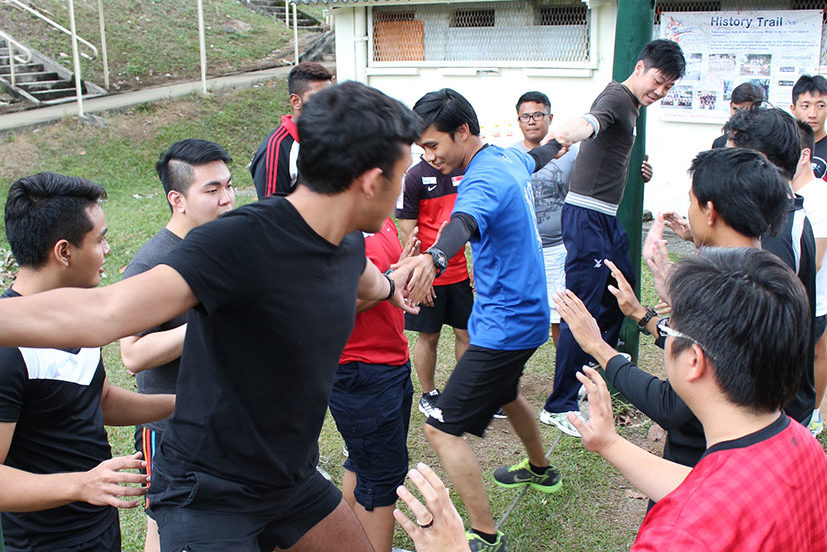
A crucible, by definition, is a container that subjects materials to intense heat to reveal their true composition. Our experiential scenarios function identically. We place your team inside carefully constructed high-pressure simulations business decision scenarios, resource allocation challenges, crisis communication exercises that mirror the exact friction points your organization faces daily.
Specifically, these scenarios are not arbitrary. Our facilitators conduct pre-engagement diagnostics with your HR leadership and department heads. We map your team’s actual pain points. We then design scenarios that force those specific dysfunctions to surface in a psychologically safe environment where failure carries no career consequence.
Furthermore, this is where local cultural competence becomes decisive. A facilitator who does not understand Singapore’s workplace dynamics will misread the room entirely. When a senior team member stays silent during a group exercise, a culturally unaware facilitator interprets this as engagement. An experienced Singapore-based facilitator recognizes it as deference to hierarchy a behavioral pattern that directly causes decision bottlenecks in real-world operations.
This is Behavioral Stress-Testing. Not entertainment. Strategic diagnosis with measurable outcomes built in from the start.
The Experience-Reflection-Application Cycle in Practice
After each scenario, our facilitators lead a structured debrief anchored in Kolb’s Reflection stage. Teams articulate specifically what happened, why they responded as they did, and what behavioral shift would produce a different outcome. Subsequently, participants receive a concrete application framework a short, actionable protocol they bring directly back to their team meetings, project reviews, and cross-functional collaborations.
This three-stage structure transforms a single training day into a behavioral inflection point. Teams do not simply remember the event. They retain the insight because they connected it to their actual work reality.
Why Singapore-Specific Context Is Non-Negotiable
Generic team building content fails Singapore organizations for a straightforward reason: the cultural variables are too significant to ignore.
Singapore’s workforce navigates a uniquely complex behavioral landscape. Multicultural team dynamics across Chinese, Malay, Indian, and expatriate professional communities create communication patterns that outsiders routinely misinterpret. The “face-saving” imperative shapes how disagreement surfaces, or more accurately, how it does not surface until it becomes a resignation letter.
Additionally, Singapore’s National Productivity and Quality Landscape pushes organizations toward efficiency metrics. However, efficiency without psychological safety produces compliant teams that never innovate. Our training directly addresses this tension. We help teams develop the behavioral vocabulary to challenge ideas respectfully, disagree productively, and take collaborative risks without triggering the kiasu-driven self-protection instinct.
Local context is not a soft consideration. It is the deciding variable between a training investment that shifts behavior and one that produces a photo for the company intranet.
From “We Had Fun” to Measurable Performance Outcomes
Our client organizations move from anecdotal team building to strategic capability development. Specifically, the outcomes we track include:
Decision-making speed under ambiguity improves when teams develop shared mental models through repeated scenario practice. Cross-functional communication friction decreases measurably when teams identify and name their specific behavioral bottlenecks. Psychological safety scores measured via pre- and post-training assessments rise when employees experience structured, facilitated vulnerability in a controlled environment. Consequently, engagement improves not because the event was enjoyable, but because individuals feel genuinely seen and heard within their professional team context.
One regional financial services firm reduced their cross-departmental escalation rate by 34% within 90 days of completing our Strategic Behavioral Stress-Testing workshop. The behavioral protocols developed during the training debrief became embedded in their standard project kickoff process. That is the difference between an event and an intervention.
Your Team’s Potential Is Already There. We Surface It.
The behavioral capability your organization needs already exists inside your people. However, it remains latent suppressed by hierarchy, habit, and the low-stakes comfort of routine office life. We create the precise conditions under which that capability becomes visible, nameable, and developable.
Furthermore, we do this within Singapore’s specific cultural and organizational context. Our facilitators are not generalists applying a Western playbook. They are experienced practitioners who understand the behavioral landscape your teams navigate every day.
Ready to stress-test your team’s potential? Contact our Team Building team to design your strategic workshop. We will build a program around your organization’s specific friction points and deliver measurable behavioral outcomes your leadership will recognize long after the training day ends.