
For programme recommendations or quotations, email us at contact@experiential-training.com

Why Your Team Agrees With Everything You Say (And Why That Should Terrify You)

Turn Team Building into Real Workplace Impact

Team Building

The last three town halls went smoothly. No hard questions. No pushback on the new direction. Everyone nodded. The deck impressed. Your leadership team left the room convinced they had a team behind them. They didn’t.

That should worry you deeply.

Silence is not agreement. Nodding is not buy-in. A meeting without conflict is not a meeting that went well. In Singapore’s corporate landscape, leaders confuse all three every single day. And by the time leaders realise none of those things were true, they’re already dealing with the consequences a strategy that nobody believed in but nobody said so, a decision that the team knew was flawed but didn’t flag, a culture where people have quietly learned that speaking up isn’t worth the risk.

This is the psychological safety crisis hiding in plain sight across Singapore’s offices from the MNC towers in Raffles Place to the regional headquarters in one-north. And it is, without question, one of the most expensive problems your organisation isn’t measuring.

What Psychological Safety Actually Means And What It Doesn’t

Before going further, it’s worth being precise. Psychological safety is not about making people feel comfortable. It’s not about being nice, avoiding difficult conversations, or creating a conflict-free environment. In fact, a team with genuine psychological safety will have more productive conflict, not less.

The concept, developed by Harvard Business School professor Amy Edmondson, defines psychological safety as the shared belief that the team is safe for interpersonal risk-taking. In plain terms: people say the hard thing out loud, and the leader’s response makes them glad they did not sorry.

That’s a very specific condition. And it’s rarer than most Singapore leaders think.

Edmondson’s landmark study of hospital teams found that the highest-performing units reported more errors not because they made more mistakes, but because they felt safe enough to surface them. The lower-performing teams appeared cleaner on paper. In reality, they were just better at hiding problems.

Sound familiar?

Why Silence Thrives in Singapore Workplaces

Singapore’s corporate culture creates particularly fertile ground for psychological unsafety and it’s worth understanding why, without romanticising or dismissing the cultural dynamics at play.

Several overlapping forces are at work. First, hierarchy is still deeply embedded in many Singapore organisations, especially those with strong Asian leadership or traditional MNC structures. Speaking up to a senior leader particularly in a group setting carries real social risk. The concept of “face,” present across Chinese, Malay, and Indian cultural contexts in different forms, means that public disagreement can feel like a personal attack rather than professional input.

Second, Singapore’s education system has historically rewarded correct answers over exploratory thinking. Many professionals enter the workforce having spent years optimising for not being wrong which makes intellectual risk-taking feel genuinely dangerous.

Third, hybrid work has made things worse. The informal corridors where people once quietly flagged concerns the kopi run, the lift ride, the five minutes before a meeting started have largely disappeared. What replaced them was the Zoom call, where silence is the default and the chat box is where real opinions go to die.

The result is a particular kind of organisational dysfunction: teams that perform adequately, avoid obvious failures, and never once tell the leader what they actually think.

The Business Cost of a Team That Won’t Push Back

Here’s where leaders need to move past the discomfort of hearing this and into the hard numbers.

Google’s Project Aristotle one of the most rigorous studies of team effectiveness ever conducted analysed 180 teams over several years and found that psychological safety was the single most important factor in team performance. Not talent density, not clear goals, and not individual brilliance. The degree to which team members felt safe to take risks and be vulnerable in front of each other.

The cost of its absence is concrete. Consider what happens when nobody pushes back:

SituationWhat Gets SaidWhat’s Actually True
Flawed strategy presented“Looks good, let’s go.”Three people spotted the gap on slide 4
Unrealistic deadline set“We’ll make it work.”The team knows it’s impossible
Poor hire made“Give it time.”Everyone knew in week two
Product decision locked“Sounds great.”Sales knew customers wouldn’t buy it
Budget cut announced“Understood.”Key people are already updating their CVs

Each of those scenarios represents a compounding cost in wasted resources, missed opportunities, and eventually, attrition. The most dangerous aspect of low psychological safety is that it’s self-concealing. The leader sees smooth meetings and takes it as a signal that things are working. The team sees smooth meetings and takes it as confirmation that honesty doesn’t pay.

How to Diagnose Psychological Safety in Your Team

The good news is that psychological safety is measurable. The bad news is that most organisations measure the wrong things engagement surveys that ask whether people are happy, rather than whether they feel genuinely safe to dissent.

A more honest diagnostic starts with behavioural observation. Ask yourself:

  • When was the last time someone in your team told you a plan wouldn’t work before it failed?
  • When was the last time someone admitted a mistake in a group setting without being prompted?
  • Do junior team members speak as much as senior ones in your meetings?
  • Does your team disagree with each other or just with external stakeholders?
  • When you ask for feedback, do you get specific, uncomfortable truths or polished, qualified praise?

If most of your answers point to silence, agreement, and carefully managed communication, you are leading a psychologically unsafe team. The question is not whether that costs you it does but how much, and whether you’re willing to do something about it before it becomes visible on a P&L.

Building Psychological Safety: What Actually Works

The research is clear on what moves the needle and most of it starts with leader behaviour, not team behaviour.

Model the vulnerability first. Psychological safety cascades downward. If leaders only ever project confidence and certainty, teams learn that uncertainty is not safe to express. When a leader says “I got that wrong, here’s what I’d do differently,” it gives the entire team permission to do the same.

Reward the messenger, publicly. The moment someone raises a difficult truth in a group setting, how a leader responds sets the temperature for every future conversation. Thanking them specifically not generically signals to everyone else in the room that speaking up has a positive return.

Separate idea generation from idea evaluation. Many teams conflate these two phases, which means people self-censor at the generation stage to avoid their idea being immediately shot down. Structured brainstorming with explicit “no evaluation yet” rules changes this dynamic fast.

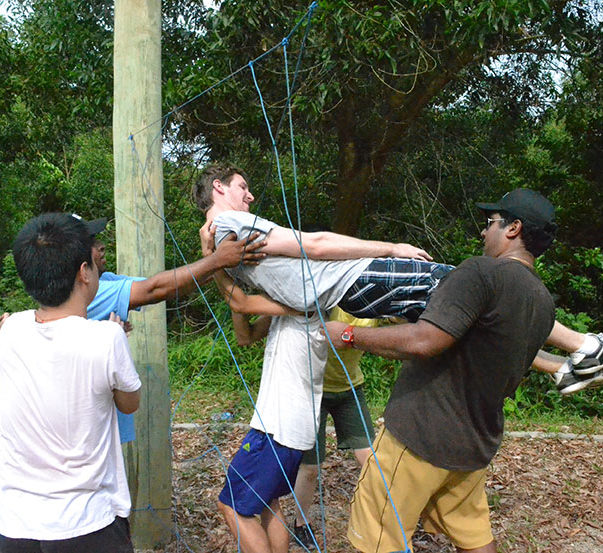
Create low-stakes practice environments. Psychological safety is a muscle. Teams that never practice interpersonal risk-taking in low-stakes settings won’t suddenly do it when the stakes are high. This is precisely where well-facilitated team building activities in Singapore create disproportionate value giving people structured, safe contexts to practice honest communication before it matters in a boardroom.

Reframe failure explicitly. In cultures where failure carries stigma, leaders need to make the reframe deliberate and repeated: “We don’t punish smart failures here. We do expect you to surface them early.” Saying it once in an onboarding deck achieves nothing. Demonstrating it when it actually happens changes culture.

How Our Team Builds Psychological Safety That Sticks

The challenge with psychological safety is that you cannot train it through a slideshow. You can explain the concept perfectly and change absolutely nothing because the barrier isn’t knowledge, it’s trust. And trust is built through shared experience, not through information transfer.

This is where our approach is genuinely differentiated. Rather than delivering content about psychological safety, their facilitated programmes create the conditions for teams to actually experience it often for the first time.

Tools like Emergenetics and MBTI/DISC profiling give teams a shared language for difference. When people understand that a colleague’s bluntness comes from a particular thinking preference rather than disrespect, or that a quieter colleague’s silence reflects processing style rather than disengagement, the interpersonal risk of speaking up drops significantly.

Structured facilitation whether in an indoor workshop setting or through an outdoor challenge creates low-stakes environments where teams practice exactly the behaviours that psychological safety requires: honest feedback, admitting uncertainty, disagreeing constructively. By the time they’re back in the office, those behaviours have a reference point.

For leadership teams specifically, the question isn’t whether your people have the courage to speak up. It’s whether you’ve built the conditions where courage isn’t required where honesty is simply the norm.

The Conclusion Most Leaders Aren’t Ready to Hear

Psychological safety is not a soft topic. It is a performance variable one that Google, Edmondson, and decades of organisational research have identified as the difference between teams that merely function and teams that genuinely innovate, adapt, and retain their best people.

If your team building activities in Singapore have focused on fun and morale but never on the conditions that make honest communication possible, you’ve been solving for the wrong thing.

The smoothest meeting in your calendar might be your most expensive one.

If you’re ready to find out what your team actually thinks and build the conditions where they’ll tell you reach out at Contact@Experiential-Training.com. Not for a programme brochure, but for a real conversation about where your team is and what it needs.

Because the question worth sitting with is this: if your team finally felt safe enough to tell you the truth tomorrow, what do you think they’d say?

đź’ˇ Key Takeaways

  • Silence is not agreement. In Singapore’s corporate culture, a smooth meeting is often a warning sign not a green light.
  • Psychological safety is a performance variable. Google’s Project Aristotle identified it as the single biggest driver of team effectiveness above talent, goals, or structure.
  • The leader sets the temperature. Psychological safety cascades downward. If leaders don’t model vulnerability and reward dissent, teams learn that honesty isn’t safe.
  • You can’t train trust through a slideshow. Shared experience not information is what shifts team behaviour. Facilitated environments give teams a place to practice before the stakes are high.

Leave a Reply

Your email address will not be published. Required fields are marked *