
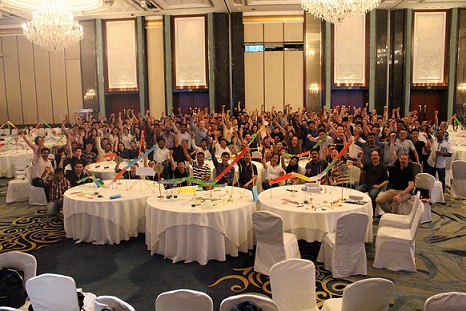
Here’s a scene we’ve watched play out more times than we can count.
Two teams get the same challenge. Build a tower, crack a puzzle, get everyone across the “minefield.” One team charges straight in. The other spends ten minutes arguing about the plan. Someone goes quiet. Someone gets frustrated. Someone says, “Can we just start?”
Afterwards, everyone laughs about it. Good day. Nice photos.
Then on Monday, the same thing happens in a project meeting. And nobody connects the two.
That gap, between what a team discovers on the day and what it does differently afterwards, is the reason we build our programmes the way we do. We don’t start with games. We start with how your people think.
The problem with “just fun” team building
Fun matters. We’d never run a day that wasn’t.
But when a team only plays, people walk away with a feeling (“that was nice”) instead of an insight (“oh, that’s why she always asks for the details first”). Feelings fade by Wednesday. Insights stick, because people can use them.
What turns a game into an insight is having a shared language to explain what just happened. That’s where profiling comes in.
What a thinking-style profile actually does
Before the day, each person completes a short online questionnaire. On the day, they get their profile back: a simple picture of how they prefer to think and behave at work.
We work with three tools, and we’ll help you pick the right one.
Emergenetics is our favourite for teams, and the one that gets the strongest feedback from our clients. It shows how each person prefers to think (analytical, structural, social, conceptual) and how they tend to behave (how expressive, assertive and flexible they are). Each profile comes as a colour-coded chart, so within minutes people can glance across the table and see the room. “Ah, we’re four greens and a yellow. No wonder nobody wanted to brainstorm.”
DISC is a four-style behavioural model that’s quick to learn and easy to remember. It works well for sales and customer-facing teams, and for groups who want a simple framework they’ll actually use.
MBTI looks at personality type and how it shows up under pressure. It works well for teams dealing with conflict or going through change.
None of these put people in boxes. A good facilitator is careful about that. The point is understanding, not labels.
Then we play, and everything makes sense
Once people know their own profile and their teammates’, the activities stop being “just games.” They become a mirror.
Here are some of the challenges we pair with profiling, and what each tends to reveal:
| If your team struggles with… | We might run… | What happens |
|---|---|---|
| Decisions that drag on forever | Lost!, a survival scenario on a deserted island | Limited time, limited resources, and the team has to agree. You’ll see who decides, who analyses and who goes quiet. |
| Messages lost between people or departments | Minefield! | Guiding blindfolded teammates through chaos using only words. Clear instructions suddenly matter a lot. |
| Resistance to change | Number Punch, inspired by Who Moved My Cheese? | The rules shift mid-game. Some people adapt fast, others hold on. Both reactions are useful to talk about. |
| Low trust or a reluctance to help | Snap! | Teammates face their “fears” (real mousetraps) and support each other through them. Usually the loudest moment of the day. |
| Silos and turf protection | The Team Mural | Each sub-team paints one part of a mural without seeing the whole. It only works if they talk across zones. |
| Negotiation, sales and customer focus | Coffee Traders | Teams trade beans, build relationships and compete to be the richest. Strategy and greed show up quickly. |
| Strategic thinking for managers | A business simulation (1–2 days) | Teams bid for contracts and manage limited resources across four “quarters” of a simulated year. |
| Settling for “good enough” | Warp Speed | A simple ball-passing task where the target keeps rising. Teams discover how much faster they can go than they assumed. |
After each activity, we stop and ask questions like: “Which thinking style drove that decision? Whose voice was missing? Where does this happen at work?”
That debrief is the part most providers skip. It’s also where the value is.
What a half-day typically looks like
Every programme is tailored, but here’s a common shape for a half-day:
- Before the day: each participant completes their profile online.
- 0:00 – 0:20: Warm-up and energiser. Nobody likes starting cold.
- 0:20 – 1:15: Profile reveal. People see their own results, then the team’s combined picture. Lots of “that explains a lot.”
- 1:15 – 2:45: Two or three challenges chosen for your team’s goals, each followed by a short debrief linked to the profiles.
- 2:45 – 3:30: Bringing it back to work. Teams agree on one or two practical changes, like how they’ll run meetings or hand over work.
Full-day programmes add more challenges, deeper profile work, or a business simulation. We also run virtual versions. One client moved a division-wide event of around 300 people online and still made it hands-on.
Who this works best for
We’ll be honest: not every team needs profiling.
If you just want a relaxing reward day after a great year, a fun activity without the profiling is perfectly fine, and we’re happy to run that too.
Profile-first team building is worth it when:
- It’s a new team, or two teams have merged, and people don’t really know each other yet.
- There’s friction between people, or between departments, that nobody quite knows how to name.
- Managers are stepping up and need to understand how to lead different kinds of people.
- The team works hard but not well together: lots of effort, too many crossed wires.
- You’ve done “fun” team building before, and nothing changed.
Questions to ask before you book
Whoever you choose, ask these. The answers will tell you a lot.
- “What happens after each activity?” If the answer is mostly about prizes, you’re buying entertainment.
- “Which profiling tools do you use, and are your facilitators trained in them?”
- “How will you link the day back to our actual work?”
- “Can you design around our specific situation,” such as a merger, a new manager, or friction between teams?
- “How many facilitators will we get?” One facilitator for 60 people means the debrief turns into a speech.
- “What’s your wet-weather plan?” (This is Singapore, after all.)
Ready to try it?
We’ve been designing and running team building and profiling workshops in Singapore for teams at banks, telcos, town councils, manufacturers and luxury brands, among others.
Tell us about your team. Share your group size, rough date and what’s going on, and we’ll suggest the right mix of profiling and activities, with a clear, line-by-line proposal.
And if profiling isn’t right for your team, we’ll tell you that too.